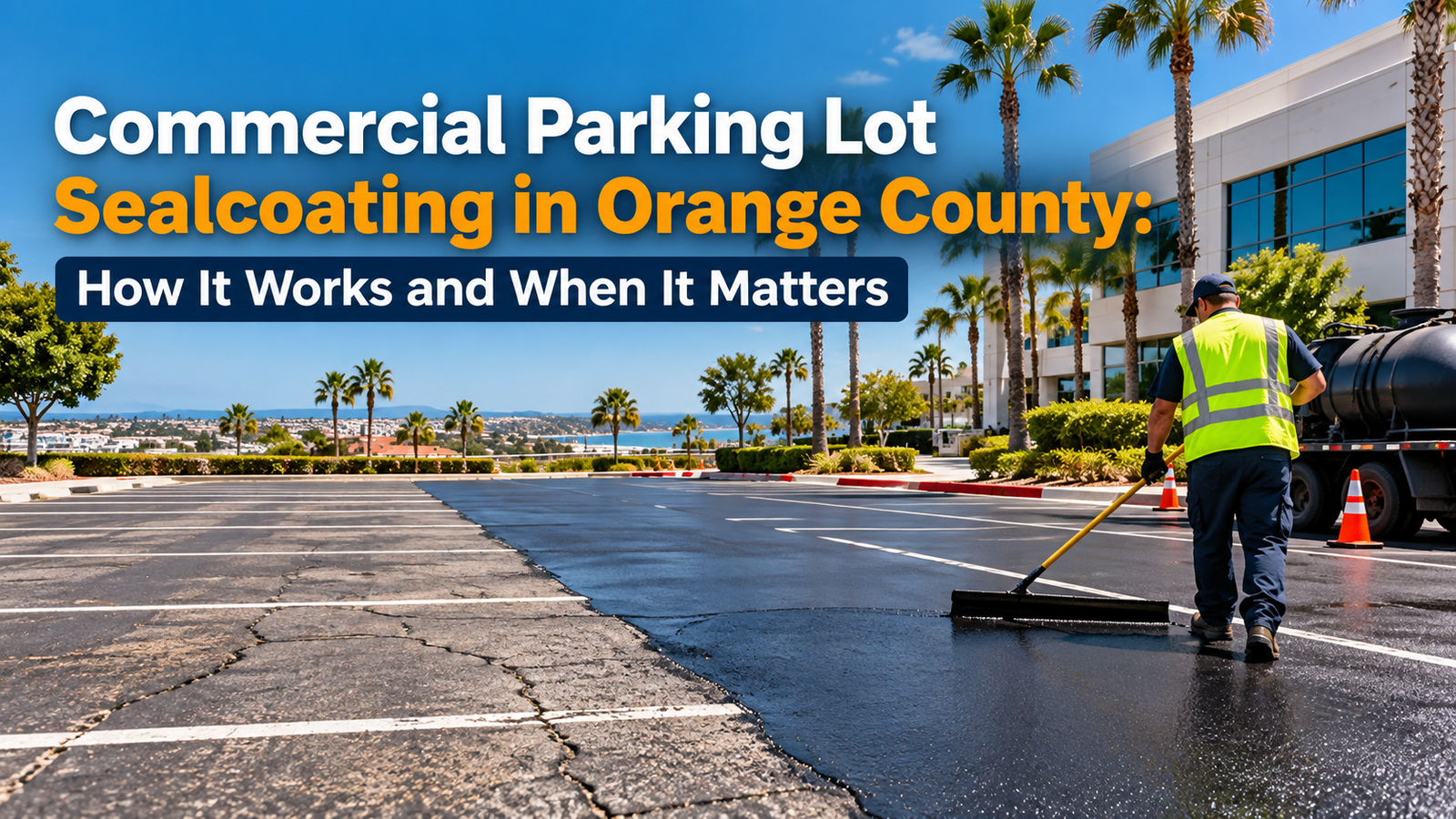
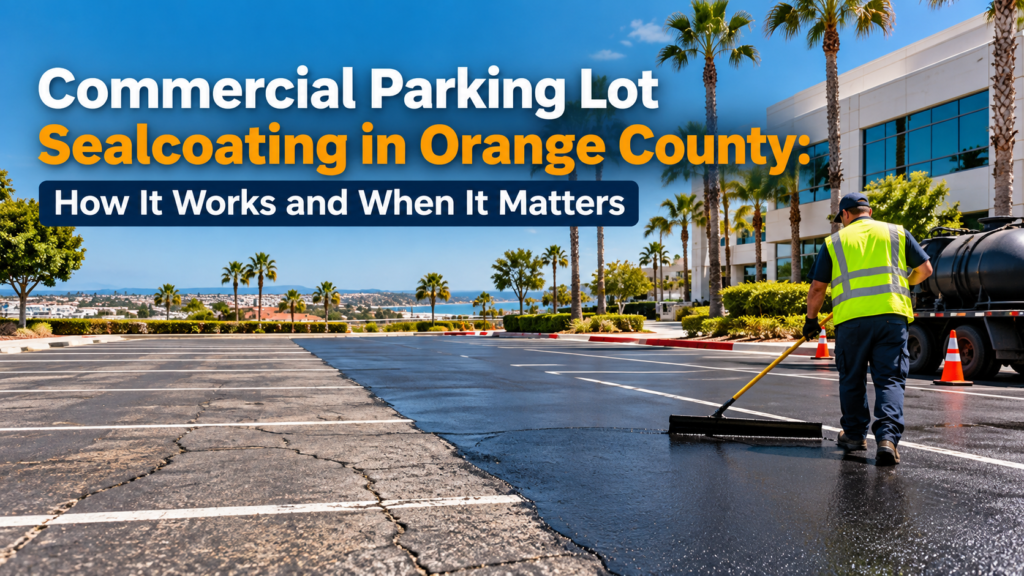
Sealcoating is one of the most widely applied asphalt maintenance treatments in the United States, and in Orange County’s intense UV and thermal environment, it plays a particularly important role in extending pavement service life. For Commercial Parking Lot Sealcoating Orange County property owners managing lots that serve retail centers, office campuses, apartment complexes, and industrial facilities sealcoating is part of a structured maintenance approach that protects the investment in the pavement structure over time.
The Oxidation Problem in Southern California
Asphalt pavement is a composite material: aggregate particles (gravel and sand) bound together by asphalt cement, a petroleum-derived binder. The binder is what gives asphalt its flexibility and weather resistance, but it is also the component that ages. Over time, the binder undergoes oxidation exposure to UV radiation and oxygen causes chemical changes that make the binder harder and more brittle.
In Orange County, the combination of intense UV radiation (the region has one of the highest annual UV indexes in the continental United States), hot summer temperatures, and minimal cloud cover accelerates oxidation significantly compared to northern or coastal climates. An asphalt surface that might remain flexible for 8 to 10 years in a moderate climate may show significant brittleness within 5 to 7 years in Orange County without protective treatment.
Oxidation is visible as a color change the surface fades from deep black to gray and as surface texture change, where aggregate particles become exposed and the surface takes on a rough, granular appearance. If oxidation continues without intervention, thermal and load cracks begin to form as the brittle binder can no longer accommodate the movement of the pavement under temperature changes and vehicle loads.
How Sealcoating Protects the Surface
A sealcoat creates a barrier between the asphalt surface and the agents that cause oxidation: UV radiation, oxygen, water, and fuel and oil drips from vehicles. The coating fills micro-voids in the surface, reduces the surface permeability, and provides a sacrificial layer that takes the UV exposure in place of the asphalt binder beneath.
In Orange County, asphalt emulsion sealcoats are the compliant product under South Coast Air Quality Management District (SCAQMD) rules coal tar emulsion products are not permitted due to their PAH content and associated water quality and air quality concerns. High-quality asphalt emulsion sealcoats, properly formulated and applied, provide effective UV and water protection while meeting regional regulatory requirements.
Sealcoat formulations typically include a polymer additive acrylic, styrene-butadiene, or other latex that increases flexibility, adhesion, and wear resistance. Sand can be added to improve traction on the surface when wet, which is a safety consideration on commercial lots where pedestrian traffic is heavy.
Surface Preparation: What Makes or Breaks the Application
The condition of the surface before sealcoating is applied determines how well the product performs and how long it lasts. A sealcoat applied to a surface with oil contamination, standing debris, or open cracks will fail prematurely oil contamination in particular prevents the sealcoat from bonding and causes it to peel.
Proper preparation begins with power cleaning the entire surface to remove debris, dirt, and loose material. Oil and fuel spots common in commercial lots where vehicles park and idle require degreasing with a detergent-based cleaner, followed by a primer application formulated to promote adhesion over oil-contaminated areas. Without this step, oil stains remain as failure points in the finished sealcoat.
All cracks must be cleaned and sealed before sealcoating. Hot-applied rubberized crack sealant is the standard for commercial lots because it remains flexible through temperature cycling and resists water infiltration. Filling cracks first prevents the sealcoat from simply bridging open voids which leads to crack re-opening through the new coating within one season.
On new asphalt or freshly overlaid surfaces, sealcoating must wait 6 to 12 months to allow the binder to cure. Applying sealcoat too soon traps lighter oils in the binder before they can properly volatilize, which can cause surface softness and sealcoat adhesion problems.
Application Methods for Commercial Lots
Commercial sealcoating is typically applied by spray equipment power sprayers that apply the material at a controlled film thickness across the lot surface. Spray application is faster than squeegee application and produces a more uniform film thickness, which is important on large commercial lots. Squeegee or brush application is used for tight spots around curbs, drains, and other obstacles where spray equipment cannot reach.
Most commercial sealcoat applications use two coats. The first coat penetrates surface voids and establishes bonding; the second coat provides the full film thickness for UV protection and wear resistance. Each coat must dry before the next is applied drying time depends on temperature, humidity, and airflow. In Orange County’s dry summer conditions, drying can be rapid, but the lot must be monitored to ensure the first coat is truly dry before the second application.
Traffic control during application and curing is essential. Foot traffic can resume within 2 to 4 hours after the final coat in favorable drying conditions. Vehicle traffic requires 24 to 48 hours for adequate cure before reopening. Parking cars too soon while the sealcoat is still soft causes tire marks, surface drag, and adhesion failure at contact points.
Sealcoating Frequency on Commercial Lots
The appropriate sealcoating interval depends on traffic volume and type, exposure conditions, and the quality of the initial application. For commercial lots in Orange County, a 2 to 4 year interval is typical. High-traffic lots with heavy vehicle movement may need reapplication every 2 years; lightly used lots in shaded or protected locations may last 4 to 5 years between applications.
The visual cue for reapplication is the appearance of the surface. When gray color and surface texture change become apparent, oxidation is progressing and a new sealcoat application is warranted. Waiting until surface cracking develops means the maintenance cycle has fallen behind crack sealing becomes an additional step before sealcoating can proceed.
Sealcoating and Parking Lot Markings
Sealcoating covers existing pavement markings, which must be reapplied after the sealcoat cures. This is often treated as an opportunity to update or refresh the lot layout adding accessible stall markings to current ADA dimensions, refreshing fire lane designations, or revising directional arrows. In Orange County, thermoplastic markings are preferred over water-based paint for their durability on commercial surfaces with high traffic.
The sequence sealcoat first, then stripe is important. Applying markings before sealcoat is complete means the markings will be covered, requiring a full set of markings over fresh sealcoat, which may not bond as well to the marking material as markings applied after the sealcoat fully cures.
Frequently Asked Questions: Commercial Parking Lot Sealcoating in Orange County
How long after sealcoating can vehicles return to the lot?
Vehicle traffic should be held off for at least 24 to 48 hours after the final coat is applied and has dried. In Orange County’s typical summer conditions, drying is often faster, but cooler or humid weather extends cure time. Turning vehicles too soon while the sealcoat is soft causes surface drag and tire marks that permanently damage the appearance.
Does sealcoating need to be applied every year?
Annual application is unnecessary and counterproductive. Sealcoat buildup from over-frequent application can lead to cracking and peeling of accumulated layers. The appropriate interval on most Orange County commercial lots is 2 to 4 years, based on observed surface condition rather than a fixed calendar schedule.
Can sealcoating be applied in summer in Orange County?
Summer is generally a good sealcoating season in Orange County because of low humidity and warm temperatures that accelerate drying. The exception is during periods of extreme heat above 100°F when the surface temperature may be too high for proper sealcoat application and curing. Early morning application, when temperatures are lower, is preferred on the hottest days.
What is the difference between sealcoating and crack sealing?
They are distinct treatments. Crack sealing specifically addresses existing cracks by injecting rubberized sealant into them. Sealcoating is a surface-wide treatment that coats the entire pavement. Crack sealing must precede sealcoating the sequence ensures that existing cracks are closed before the surface-wide protective layer is applied.